
Everest Base Camp Trek 14 Days
Trip Facts
Overview
The Everest Base Camp Trek 14 Days is one of the most recognized trekking journeys in the world, taking you deep into the Khumbu region of Nepal to stand at the base of the highest mountain on Earth, Mount Everest (8,848.86m). This classic Himalayan route combines mountain landscapes, Sherpa culture, suspension bridges, ancient monasteries, glacial rivers, and high-altitude adventure into one powerful experience. Starting with a thrilling mountain flight to Lukla, the trail follows the Dudh Koshi River through pine forests and traditional villages like Namche Bazaar, the vibrant heart of the Khumbu region. As the days pass, trekkers gain altitude gradually, allowing the body to adapt while the views expand to include towering peaks such as Lhotse, Ama Dablam, and Nuptse.
This region opened to foreign trekkers in the mid-20th century and gained worldwide recognition after the successful ascent of Everest by Sir Edmund Hillary and Tenzing Norgay in 1953. Since then, the Everest Base Camp trail has become a dream destination for adventure lovers. But this trek is not only about reaching base camp. It is about walking through Sherpa villages, spinning prayer wheels in monasteries like Tengboche Monastery, crossing high suspension bridges decorated with prayer flags, and witnessing the dramatic Khumbu Glacier up close. At Shalom Adventure Holidays, we design this trek with careful acclimatization, experienced guides, and personalized service to ensure your journey is safe, meaningful, and deeply memorable.
Itinerary
Your journey officially begins the moment you land at Tribhuvan International Airport. As you step outside the terminal, the air feels different — a mix of incense, dust, and city life. Kathmandu is alive. Honking vehicles, colorful prayer flags, ancient temples tucked between buildings, and the organized chaos of a Himalayan capital immediately welcome you.
After meeting our representative, you’ll transfer to your hotel. On the drive, you will notice old brick houses with carved wooden windows, street vendors selling fruits, and locals going about their daily routines. This is your first introduction to Nepal’s culture — vibrant, spiritual, and deeply traditional.
In the evening, we hold a detailed trek briefing. This session is very important. We don’t just explain the route — we prepare you mentally and physically. You’ll learn how altitude affects the human body, why walking slowly is critical, how hydration plays a major role in acclimatization, and how to layer your clothing properly for changing mountain weather. Your trekking gear will be checked carefully, and any missing items can still be arranged in Kathmandu. By the end of the meeting, you won’t feel nervous — you’ll feel ready.
- Altitude: 1400
- Accommodation: Hotel in Kathmandu
- Meals: Welcome Dinner
The morning begins early. The flight to Tenzing-Hillary Airport is short but unforgettable. As the small aircraft flies between massive hills and snowy peaks, you’ll witness dramatic Himalayan landscapes from above — deep valleys, scattered villages, and distant white summits rising through clouds.
Landing in Lukla is thrilling. The runway sits on a mountainside, short and sloped. Once outside the plane, you immediately feel the crisp mountain air. The noise of the city is gone — replaced by wind, distant yak bells, and trekkers preparing for adventure.
The trail begins with a gentle descent through small Sherpa settlements. You’ll pass mani stones carved with Buddhist prayers and spin prayer wheels as locals do. The path follows the beautiful Dudh Koshi River, whose glacial water rushes below suspension bridges. Pine trees line the trail, and you’ll see porters carrying heavy loads with incredible strength.
Today’s walk is not difficult. It allows your body to adjust gradually. By the time you reach Phakding, you’ll have experienced your first real Himalayan trekking day — simple, peaceful, and exciting.
- Altitude: 2610
- Accommodation: Teahouse
- Meals: Breakfast, Lunch, Dinner
Today is your first physically demanding day, and you will truly feel that you are entering the Everest region.
The trail continues along the Dudh Koshi River, crossing several high suspension bridges that sway slightly as you walk. The most famous one is the Hillary Bridge — hanging dramatically above a deep gorge. Looking down at the rushing river below is both thrilling and humbling.
After crossing the final bridge, you enter Sagarmatha National Park, a protected UNESCO World Heritage Site. The real climb begins here. The uphill section to Namche is long and steady. You will walk slowly, focusing on breathing rhythm and step control. This is where trekkers learn an important lesson: Everest Base Camp is not about speed — it is about patience.
Halfway up, if the weather is clear, you may catch your very first glimpse of Mount Everest far in the distance. That tiny black pyramid peak between Lhotse and Nuptse creates a powerful emotional moment. Suddenly, everything feels real.
Namche Bazaar appears like a bowl-shaped village carved into the mountainside. It is the trading hub of the Khumbu region, full of bakeries, trekking shops, cafes, and lively energy.
- Altitude: 3440
- Accommodation: Lodge
- Meals: Breakfast/Lunch/Dinner
Acclimatization does not mean staying in bed. It means hiking higher and sleeping lower.
Today you hike up to the famous Everest View Hotel, one of the highest hotels in the world. The uphill walk helps your body adapt to thinner air. From the top, you are rewarded with breathtaking views of Everest, Lhotse, and the incredibly beautiful Ama Dablam.
You’ll also visit the Sherpa Culture Museum, where you learn about:
- The history of Everest expeditions
- Sherpa mountaineering achievements
- Traditional Himalayan lifestyle
The afternoon is relaxed. You can explore Namche’s local market, enjoy fresh bakery items, or simply sit with tea and admire the surrounding peaks. Your body is slowly producing more red blood cells — preparing you for higher elevations ahead.
- Altitude: 3440
- Accommodation: Lodge
- Meals: Breakfast/Lunch/Dinner
This section of the trail offers continuous mountain views. The path contours along the hillside, allowing you to walk while admiring Everest, Lhotse, and Ama Dablam almost the entire time.
After descending to the riverside village of Phunki Tenga, you begin a steady uphill climb through rhododendron and pine forest. If trekking in spring, the forest blooms with red and pink flowers.
Tengboche is home to the magnificent Tengboche Monastery, the spiritual center of the Khumbu region. If timing allows, you can witness monks chanting evening prayers. The sound of horns and rhythmic chanting, combined with the backdrop of Ama Dablam, creates an unforgettable Himalayan atmosphere.
- Altitude: 3860
- Accommodation: Lodge
- Meals: Breakfast/Lunch/Dinner
Today the landscape begins to change dramatically. Trees slowly disappear as you gain elevation. The trail opens into wide valleys surrounded by towering peaks.
You pass through Pangboche village, one of the oldest Sherpa settlements in the region. The terrain becomes drier and more rugged. Stone walls surround small agricultural fields, protecting crops from strong winds and grazing animals.
Dingboche sits beautifully in the Imja Valley, with Ama Dablam standing prominently nearby. The air now feels noticeably thinner. Simple movements require more effort. Hydration and slow walking become extremely important.
- Altitude: 4410
- Accommodation: Lodge
- Meals: Breakfast/Lunch/Dinner
You hike to Nangkartshang Hill for further acclimatization. The climb is steep but rewarding. From the top, you can see Makalu in the distance, along with Ama Dablam and Island Peak.
At this altitude, your body is adapting to nearly 5,000 meters. You may feel slightly tired or short of breath — this is normal. The key is slow movement, good nutrition, and rest.
- Altitude: 4410
- Accommodation: Lodge
- Meals: Breakfast/Lunch/Dinner
As you leave Dingboche, the vegetation becomes minimal and the terrain turns more rugged and alpine. The trail begins gradually, crossing wide open yak pastures with towering peaks surrounding you in every direction. The landscape now feels wild and raw — less green, more rock, more sky.
You slowly ascend toward Thukla. The air is noticeably thinner now, and even small inclines demand controlled breathing. After crossing a small wooden bridge, the trail climbs steeply up to Thukla Pass. This section is short but physically demanding due to altitude.
At the top, you reach a deeply emotional place — memorials dedicated to climbers who lost their lives on Everest and nearby peaks. Stone chortens and prayer flags stand against the harsh mountain backdrop. It is a quiet reminder of the power of the Himalayas. Most trekkers naturally pause here in silence.
From here, the trail becomes gradual again as you walk alongside the massive Khumbu Glacier. You can see icy ridges and hear the distant cracking sounds of shifting ice. Lobuche appears as a small cluster of lodges surrounded by rocky terrain. Nights here are cold, and temperatures often drop below freezing. You will feel the altitude — slight headaches or reduced appetite can occur — but with proper hydration and rest, your body continues adapting.
- Altitude: 4910
- Accommodation: Lodge
- Meals: Breakfast/Lunch/Dinner
This is the day you have been waiting for.
The morning begins with a slow walk toward Gorakshep, the last settlement before Base Camp. The trail undulates over rocky glacial moraine. There is no greenery here — only rock, ice, and towering peaks. You are walking on terrain shaped by the Khumbu Glacier over thousands of years.
After a short rest and lunch at Gorakshep, you continue toward Everest Base Camp. The path is uneven and rocky, requiring careful footing. As you move closer, colorful prayer flags and expedition tents (during climbing season) become visible.
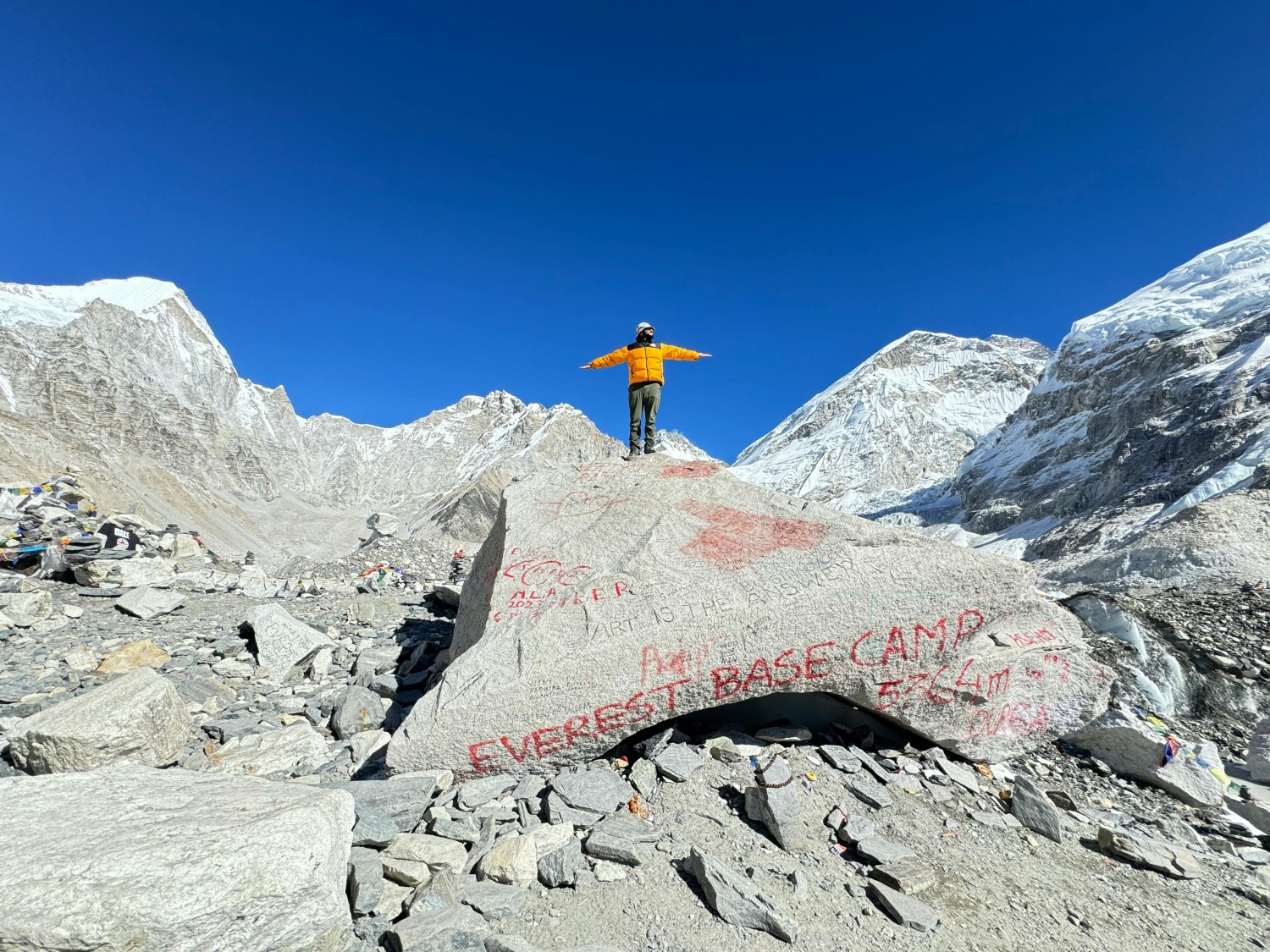
Reaching Base Camp is not dramatic in terms of a huge summit view of Everest — but emotionally, it is powerful. You are standing at 5,364 meters, at the foot of the world’s highest mountain. You see the Khumbu Icefall rising ahead — a chaotic maze of ice blocks and crevasses that climbers must cross to summit Everest.
Trekkers usually celebrate here with photos, hugs, and quiet reflection. After spending time absorbing the moment, you carefully retrace your steps back to Gorakshep for overnight stay. The return feels tiring but deeply satisfying.
- Altitude: 5364
- Accommodation: Lodge
- Meals: Breakfast/Lunch/Dinner
Before sunrise, you begin one of the most rewarding climbs of the entire trek — up to Kala Patthar. The climb is steep and slow, especially at this altitude. Every step requires effort. Your breathing is deep and steady. The sky slowly changes color from dark blue to soft orange.
At the top, you are rewarded with the clearest and closest view of Everest you will experience during the trek. Unlike Base Camp, here Everest stands fully visible, rising sharply beside Nuptse and Lhotse. As the first sunlight hits the summit, the peak glows golden. This is a silent, emotional moment for many trekkers.
After descending back to Gorakshep for breakfast, the long descent begins toward Pheriche. With every meter you descend, oxygen levels increase and your body feels slightly stronger. The landscape gradually shifts from rocky glacier terrain back to alpine valley. By the time you reach Pheriche, you feel both exhausted and proud — you have successfully reached the highest point of the trek.
- Altitude: 5545
- Accommodation: Lodge
- Meals: Breakfast/Lunch/Dinner
Today’s walk feels very different from the ascent days. You are descending, breathing more comfortably, and moving with greater confidence. The trail retraces through Pangboche and Debuche before reaching Tengboche once again.
Going downhill requires attention to knees and balance, especially on stone steps. The forest sections feel greener and more alive compared to the higher elevations. The air feels richer.
After lunch, you continue descending toward the Dudh Koshi River before making the final climb back up to Namche Bazaar. Although descending overall, this last uphill stretch reminds you that the trek is not finished yet. Arriving back in Namche feels familiar — warm bakeries, shops, and the sense of returning to a lively mountain town.
- Altitude: 3440
- Accommodation: Lodge
- Meals: Breakfast/Lunch/Dinner
Your final trekking day begins with a long descent toward the Dudh Koshi River. You cross familiar suspension bridges and pass villages you saw earlier in the journey. Everything feels slightly different now — you are more confident, more experienced, and physically stronger than when you began.
The repeated ups and downs of the trail test your remaining energy, but mentally you feel accomplished. Reaching Lukla is emotional. This is where your trekking journey began, and now you return having completed one of the world’s most iconic adventures.
In the evening, you gather with your guide and porters for a farewell dinner. Stories are shared, laughter fills the dining room, and you celebrate the teamwork that made the journey successful.
- Altitude: 2860
- Accommodation: Lodge
- Meals: Breakfast/Lunch/Dinner
Weather permitting, you board the morning flight from Lukla back to Kathmandu. Looking out the window, you see the Himalayan peaks one last time — now with a deep sense of connection.
Upon arrival in Kathmandu, the busy city feels very different than it did on Day 1. You now carry mountain memories, high-altitude experience, and a new appreciation for comfort. A hot shower and soft bed feel luxurious after days in teahouses.
The evening is free for shopping in Thamel, enjoying Nepali cuisine, or simply relaxing.
- Altitude: 1400
- Accommodation: Hotel in Kathmandu
- Meals: Breakfast/Lunch/Dinner
Your Everest Base Camp journey officially concludes today. After breakfast, you are transferred to Tribhuvan International Airport for your onward flight.
As you leave Nepal, you do not just carry photographs. You carry the experience of walking through the heart of the Himalayas, standing at Everest Base Camp, witnessing sunrise from Kala Patthar, and learning patience, resilience, and respect for high mountains.
This trek is not only a physical journey — it becomes a personal achievement that stays with you for life.
- Meals: Breakfast
Our Cost's
Cost Includes
- Airport pickup and drop-off
- Domestic flights (Kathmandu–Lukla–Kathmandu)
- Two night accomodation in kathmandu hotel with breakfast
- Sagarmatha National Park permit
- TIMS card
- Licensed English-speaking trekking guide
- Porter service (1 porter for 2 trekkers)
- Accommodation in teahouses during trek
- Breakfast, Lunch, and Dinner during trekking days
- First aid kit and oximeter monitoring
- Trekking Gears if needed
Cost Excludes
- International airfare
- Nepal visa fees
- Travel insurance (mandatory)
- Personal trekking gear
- Extra beverages and snacks
- Hot showers, Wi-Fi, charging fees
- Tips for guide and porter
FAQ's
This trek is considered moderate to challenging. No technical climbing is required, but daily walking of 5–8 hours at high altitude demands good physical fitness and mental determination.
Previous trekking experience is helpful but not mandatory. With proper preparation and pacing, beginners with good fitness can complete this trek.
Altitude sickness can occur above 3,000 meters. Our itinerary includes acclimatization days, and our guides monitor oxygen levels regularly to reduce risks.
Spring (March–May) and Autumn (September–November) offer stable weather and clear mountain views.


